
Woobiweb
What was the problem?
Many craftsmen and small operators in the construction industry manage quotes, customers, confirmations, and payments through different tools, often poorly connected to one another.
A document prepared on a computer, a PDF sent by email or WhatsApp, a confirmation received in a message, payments noted elsewhere.
Individually, each of these tools can work. The problem arises when they must become parts of the same process.
Woobiweb was born from this, with a very concrete initial goal: to allow a professional to create, send, and have their quotes signed easily, especially from their phone.
The mobile dimension is not a later adaptation of the project. It is part of the problem to be solved: those who use Woobiweb may be at a client's location, on a construction site, or on the move and should not be forced to return to a computer to complete administrative work.
How did I reason through it?
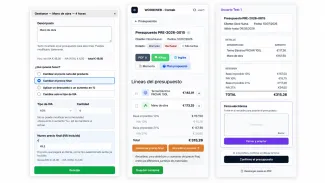
The first version of Woobiweb was built around the quote: customers, materials and work, prices, VAT rates, document generation, online sharing and acceptance.
But the project did not remain a prototype. It entered the daily use of a professional, and precisely this use began to show that the problem was broader.
After a quote is accepted, the real work actually begins. There are deposits, installments, and a balance to manage. There may be expenses and financial transactions to link to the job. And other professionals often get involved.
A plumber may need an electrician or a mason. One of the operators can coordinate the project, directly request a quote from the people they usually collaborate with, and maintain the relationship with the client.
There is no need to necessarily turn these relationships into a marketplace in which unknown professionals compete to obtain an assignment. Very often professional relationships already exist.
The problem then becomes making clearer and traceable what happens between people: what was requested, what was quoted, what was accepted, which activities are ongoing, and which financial transactions belong to each job.
From these observations comes the planned evolution of Woobiweb toward the management of work, financial operations, and collaboration among multiple operators.
Artificial intelligence is also among the possibilities I am exploring, but as a support tool. It can help, for example, turn the description of a job into a first structured draft. Prices, amounts, terms, assignments, and confirmations must instead remain explicit and controllable data.
Two principles guide this evolution: clarity and traceability.
What changed?
Woobiweb is today an operational application, used regularly to prepare and manage quotes from mobile.
The professional can build the quote starting from materials and work processes, manage prices and VAT rates, generate the PDF, share it with the customer, and define a payment plan with down payments, installments, and balance.
The customer accesses their own view of the quote and can accept it online, via electronic signature or explicit confirmation.
The most interesting result, however, is what is happening after the first version.
Daily use is bringing new problems to solve to the surface and is progressively indicating the direction in which to evolve the product. Financial management of the job, progress states, collaboration among multiple operators, and artificial intelligence tools belong to this evolution and are not presented as already available features.
Backward compatibility with what is already in use remains a requirement: the evolution of the product must not interrupt the processes that work today.
Woobiweb thus represents a way of building software that I consider particularly important: start from a concrete problem, build something that can actually be used, observe what happens, and let usage also indicate the next step.
Measurable outcomes